


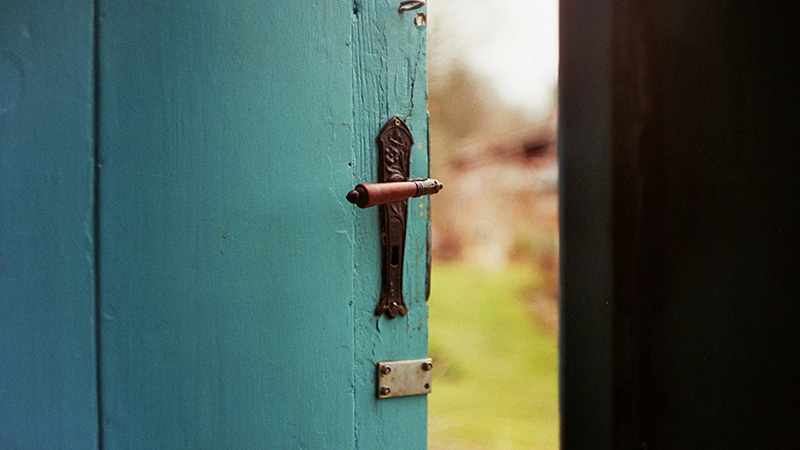
Photo by Jan Tinneberg on Unsplash
The Open Gate
2026-07-22T04:00:00.000Z
Pushing, pulling, nothing worked. The door was locked. At 8 a.m. it was supposed to be open, and she couldn't see through the tinted glass. She had work to do, and she needed her coffee. Maybe if she pushed harder, she would get what she wanted. Maybe she could think her way out of it, mapping in her mind all the other cafes within a 2-mile radius. Now her head was blocks away as her hand kept rattling the door. If only her eyes were there to see the unassuming sign: "Enter through the side gate."
The door was never the problem. The problem was distance. Not physical distance, but the distance between mind and moment when thoughts search elsewhere. The Buddha often encouraged not thinking harder but seeing more clearly, beyond preconceptions of what should be. In the Bāhiya Sutta, he says, "In the seen, there is only the seen." Jesus also warns against overthinking when he says, "Though seeing, they do not see." (Matthew 3:13) Both point to the same unveiling. When attention returns to what is directly before us, the world becomes intelligible again. What seemed closed begins to open, not through effort, but through presence.
When something isn't working, and when the mind starts searching for answers somewhere else, pause for a moment.
- Stop pushing. Let the body become still and take one slow breath.
- Return to the senses. Notice what is directly present: a sound, a color, the feeling of the ground beneath your feet.
- Look again. Without analyzing or planning, simply observe what is in front of you.
The fruit of this practice is clarity. A small pause interrupts the habit of living in thought. In the practice of mindfulness, attention returns to the body, the breath, and the immediate world. Again and again, the mind wanders into abstraction; again and again, we come back. Reality often reveals what thinking could not: the gate is already open.
- Infinite Prayer — digital art installation that constantly generates pleas for peace